


 Free Newsletter

Columbia River Crossing is starting to feel like the aerial tram all over again
By: Robert Seitzinger//November 8, 2011//
Columbia River Crossing is starting to feel like the aerial tram all over again
Robert Seitzinger//November 8, 2011//

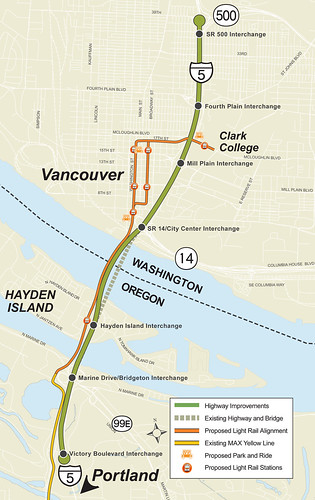
In the past three months, the long-awaited has drawn the ire of several groups that聽filed appeals relating to the bridge’s construction, and it has聽yielded dissatisfaction from governors of both states the bridge would connect. The CRC has been the Great White of projects for decades among development, construction, architecture, engineering and several other professionals in the Pacific Northwest 鈥� an elusive, prestigious job that makes and breaks careers.
Projects of this magnitude are lightning rods of public discourse and legal bickering. The biggest issue facing such a project is that big money gets spent long before ground is broken. Consulting fees, surveying costs, design mock-ups…the list of expenses is long, varied, and very expensive.
Remember the ? That fantastic sky-bound cable car after initial estimates set the project around a quarter of that final figure; the CRC is currently estimated to cost $3.1 billion.
Quadrupling that number is far from anything the state of Oregon or the state of Washington budgets can stretch to cover should “unforeseen complications” arise. What’s more, this bridge won’t be open for traffic until 2018, assuming that everything goes off without a hitch.
The counterpoint to pessimism here is that, unlike the tram, the CRC has oversight in place from two states, alongside the bureaucracy of local, state and federal dollars being applied to the project. That’s a hard sell to residents who lived through the ever-evolving struggles of the tram, especially when governors are shooting down designs and business associations are filing appeals.
is a self-described collective of concerned citizens, an online outlet for voicing issues with the CRC that focuses on alternatives to a new 12-lane behemoth.聽聽Much of that site’s content contrasts with the blue-sky horizon being presented by the official CRC website, and that struggle is indicative of the ongoing news coverage, the throng of blogs, the schedule of public meetings and the general discussion pertaining to the CRC and its related issues.
Whichever side of the debate one takes, it seems the CRC has shifted from a far-future possibility to a near-certain project that will be the belle of the development ball for the next decade. What’s needed now is for the CRC project to either fold completely, or else for a clearly defined strategy to surface for public understanding. We’re at the point the tram was at in 2002, when opposition to the project was quelled by the promise of a functional, practical, affordable project that would yield a new method of transit and benefit residents.
Here’s to hoping the CRC doesn’t get to the state the tram project was in circa 2006, when the loss of trust from the public of its leaders resulted from massive overruns, budget swelling, and unending delays.
Photo courtesy of WSDOT vai Flickr
News
- Multnomah County commits up to $101.6M for Moda Center
- Portland code changes to take effect in November
- Los Colibris project approved for Portland’s OMSI District
- Pacific Northwest projects totaling $9.9 million in top bidders | Aug. 7, 2026
- Oregon opens infrastructure grant program
- Ex-TV host claps back at Detroit officials in blight case
- 31-unit multifamily project in Portland land use review intakes | Aug. 3, 2026
- $2.4 million office renovation in Portland building permits | Aug. 3, 2026
- Transportation commission weighs ODOT budget cuts
- Lam Research planning $1.7 billion investment in Tualatin
- Pacific Northwest projects totaling $10.6 million in top bidders | July 31, 2026
- Many Oregon counties struggling to maintain their fairgrounds


Commentary
- Beware of when the debt collector comes calling | Opinion
- Assembly of a future workforce begins with an invitation | Opinion
- Beware of overlooking legal requirements for remote workers | Opinion
- Become a critical thinker and transform a workplace | Opinion
- Managing construction risks with international suppliers | Opinion
- A rally with many engines: the lesson of 2026’s first half | Opinion
- Oregon housing challenges persist despite sound and fury | Opinion
- When does an employee’s bullying become harassment? | Opinion
- Ditch disorganization 鈥� the cost of deferred decisions | Opinion
- Consider 10 common risks for healthcare construction projects | Opinion
- Clarifying the reach of a law regarding prevailing wage | Opinion
- Adjust to legal changes now to ensure compliance later | Opinion
